
Evolution of the Wave

In Pasadena, the California coastline feels a world away. Tucked roughly twenty miles inland from the Pacific, Pasadena is home to the Norton Simon Museum, a sleek brown structure with the San Gabriel Mountains rising behind it. Visiting the museum for the second time last week, I expected to gravitate toward the intimate space of a small Vuillard that had captured my attention during my first visit last July. This time, though, I found myself stopped in front of a different painting—one I had completely missed—Emil Nolde’s The Sea I.
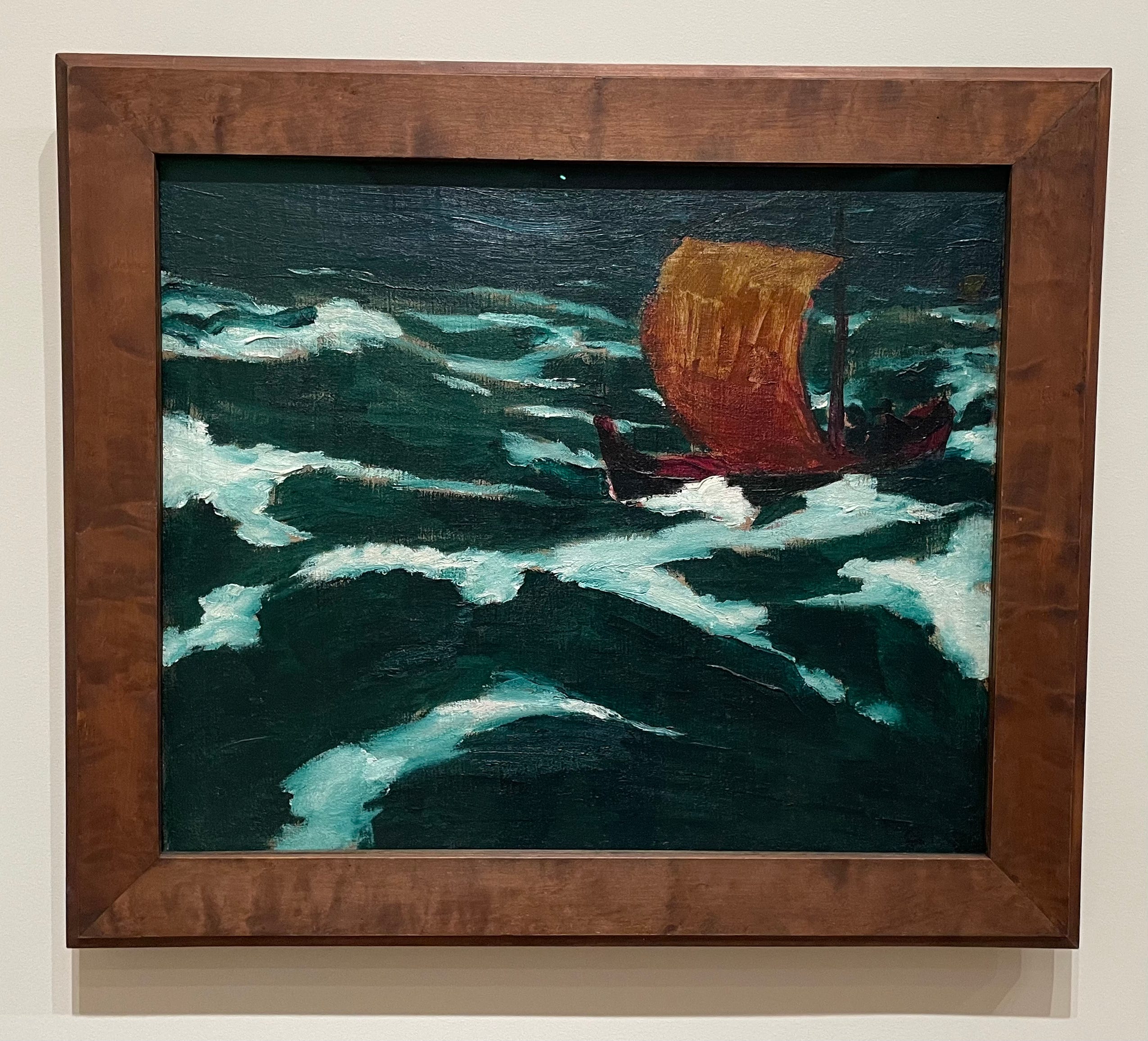
Executed in 1912, the painting depicts a boat on choppy waters, a scene perhaps set in the North Sea, where Nolde grew up along the German coast. Standing in front of The Sea I, I felt myself almost fall into the canvas, observing the rhythm between the curve of the ship’s hull and the undulation of the surrounding waves. The sail is a dramatic interruption, set nearly perpendicular to the boat, a spectrum of golden brown descending into marooned ochre. The dark bluish-green water blends into a similarly colored sky at the horizon, the disappearance of the whitecaps the only separation between sea and sky. And even those whitecaps are rarely truly white: gray-blue is layered over them, except for a few luminous moments. The ship’s hull carries the blackish silhouette of two figures, the darkest hue in the painting alongside the bow, revealing that, as dark as the sea is, it is never truly black. The largest of these luminous moments occurs right at the bow, where Nolde creates a distinct chiaroscuro: untouched white surf crashes against the ship’s dark body.
Within the motion of The Sea I’s blue-green hues, my mind kept drifting to Jackson Pollock—specifically his 1947 canvas Full Fathom Five. One of Pollock’s most iconic drip paintings, Full Fathom Five is, at first glance, a weave of long, splattered lines of white and black paint laid over a blue-green ground. Peering closer, that blue-green gives way to specks of purple, orange-brown, and dark blue, among other colors. The hues feel less like a direct match than an evolution, but their interaction—harmonious, colliding—created a distinct link in my mind.
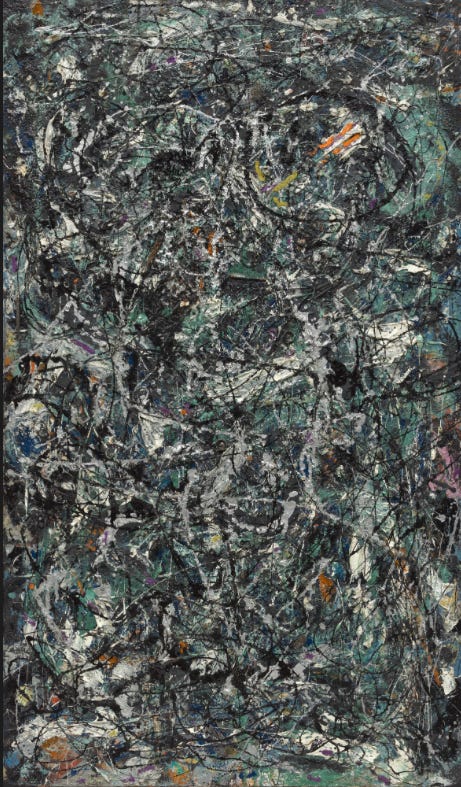
The title, Full Fathom Five, is a reference to a song in Shakespeare’s The Tempest - “Full fathom five thy father lies.”1 “Full fathom five” means five fathoms underwater—around thirty feet, since each fathom is six. Shakespeare’s song recounts a death at sea that becomes a moment of transformation. Pollock’s canvas captures the depths of five fathoms, its swirls of paint interlaced in a similar transformation, the dominating white and black streaks a dance between life and death. Pollock himself acknowledged the sea’s role in his work, saying:
“My concern is with the rhythms of nature…the way the ocean moves.”2
From his home in Springs, East Hampton, Pollock lived a ten-minute drive from the sea, a force he seems to have internalized—much like Nolde with the North Sea. The “rhythms of nature” Pollock describes are present in both canvases: Nolde captures the rhythms of the ocean’s surface, while Pollock explores the rhythms of its depth.
Pollock’s action painting—pouring paint directly from the can onto a canvas on the floor—creates wave-like motion in Full Fathom Five, deepening its connection to the ocean. The Sea I depicts waves; Full Fathom Five captures the energy of the wave in long, splattered lines of paint. Of course, there are no breaking whitecaps five fathoms deep, but Pollock creates an oscillation that recalls the surface above.
Putting the paintings in dialogue creates a timeline of how motion—and the “wave”—changes across three decades of painting. Full Fathom Five can feel like an extreme jump from The Sea I, yet the two works trace an arc from Nolde’s German Expressionism to Pollock and the Abstract Expressionists. Expressionism embraced free, raw brushwork and dense, textured paint—qualities that generate the intensity of The Sea I3. Modernism would carry those developments forward, and their next step is easy to see in Abstract Expressionist works such as Full Fathom Five. Both paintings are scenes of action, each capturing, in its own way, the ocean and the “rhythms of nature.”
Seen together, Nolde and Pollock don’t feel like an extreme jump so much as a shift in where the wave lives: from the surface of the sea to the surface of paint. Despite sitting deep in the hills, far from the Pacific, I found waves at the Norton Simon.
https://www.poetryfoundation.org/poems/47418/song-full-fathom-five-thy-father-lies-?utm
https://assets.moma.org/documents/moma_catalogue_226_300198616.pdf
https://www.tate.org.uk/art/art-terms/e/expressionism?utm
Thank you for drawing this connection to Pollock. I'm always flailing when I look at his work, but here you've offered me a buoy. "The rhythms of surface vs. the rhythms of depth" My goodness!
Another exceptional essay, Luca. Close observation seems to carry you away again and again into your vast range of experiences. It’s remarkable how you connect the moments and recognize affinities.