
Rousseau Without Borders

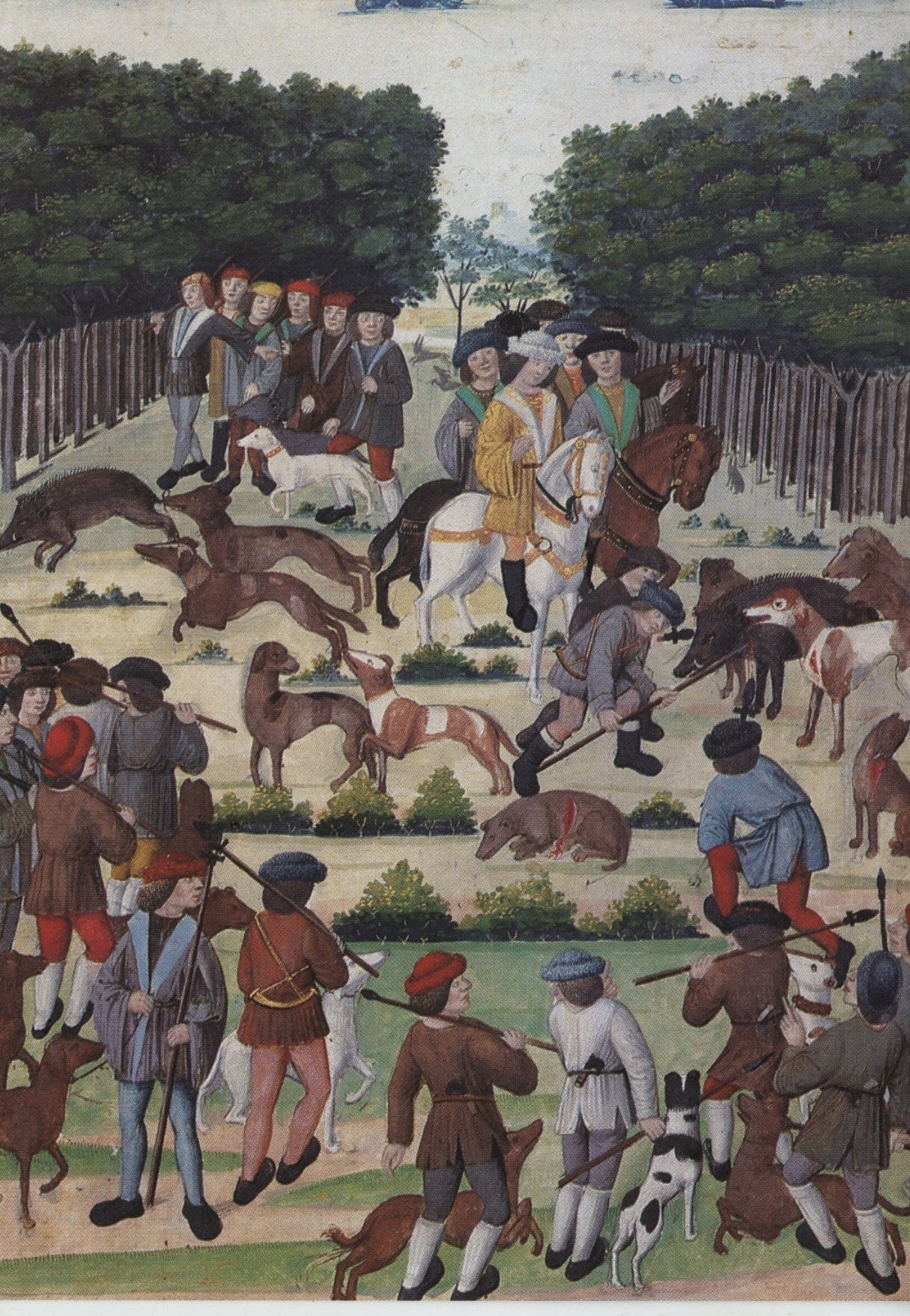
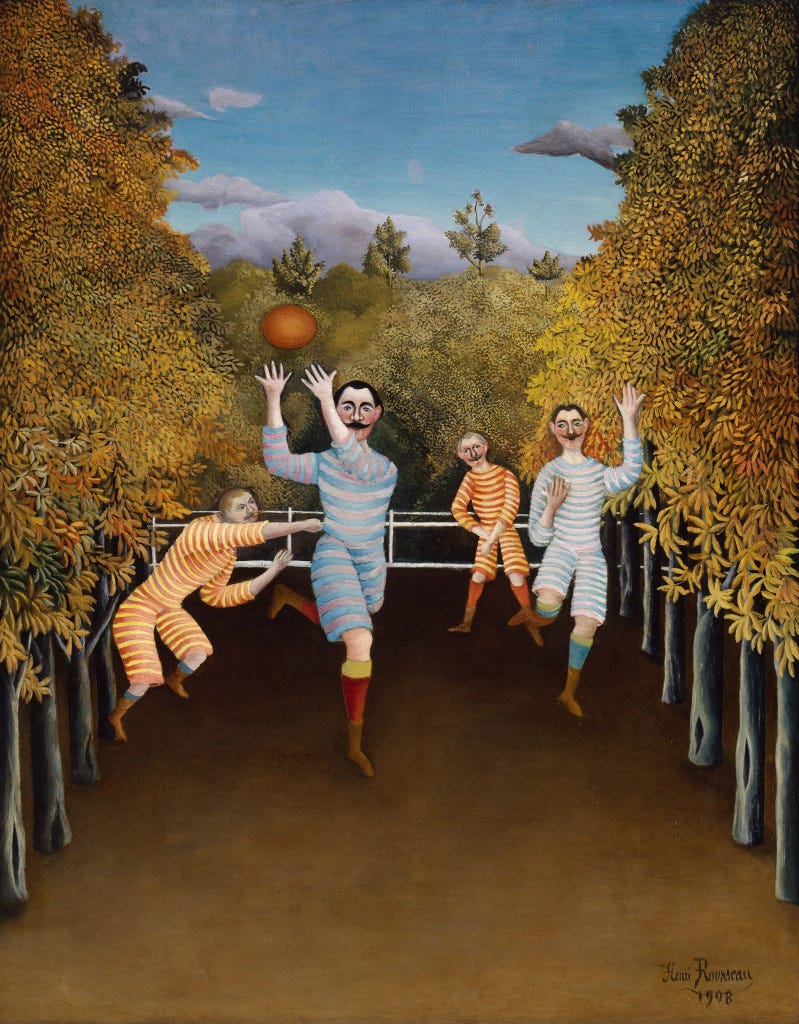
A few weeks ago, at the Musée Marmottan Monet in Paris’ 16ème arrondissement, I discovered a series of 15th century painted tablets. Under the glass some hundred tablets are arranged side-by-side, and as my eyes traveled across the works, I was quickly drawn to a tablet called L’Amiral de Graville chassant le sanglier, a scene by an anonymous artist from the École Française of hunters, dogs, and horses from 1493. The figures and their animals are flattened and stacked upon one another, with little concern for perspective, as the figures in the foreground are the same size as their counterparts further up the field. The activity takes place in a central plane, flanked by a cluster of trees on each side of the tablet. The army-green leaves and light brown trunks create the perspective in the scene, as their diagonal positioning creates the effect of deep space. This plane of activity surrounded by forestry quickly brought to mind another French painting from some five centuries later — Henri Rousseau’s The Football Players from 1908. Similar to the tablet, the tree trunks create a stage for the action, as the graceful prance of the players in light-blue stripes is contrasted by the frustrated punch and seeming dejection of their opponents. Like his 15th century predecessor, Rousseau flattens the men within the space and does not become overly concerned with depth. Considering the parallels between the two works changed my perspective on Rousseau, giving me license to better view his work in dialogue with his predecessors as well as his successors.
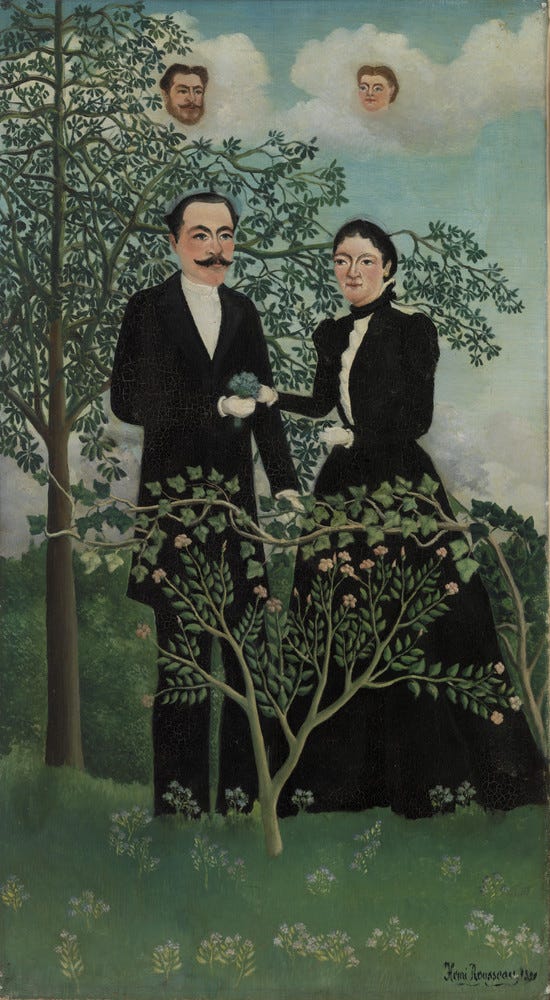
Earlier this week, I made my way through the Tuileries, descending the stairs of the Orangerie to the first gallery of Henri Rousseau’s landmark retrospective. With some fifty works, the exhibition brings together Rousseau’s most iconic paintings with many lesser-known compositions from earlier in his career. The exhibition text notes the connection between Rousseau’s portraits and Italian and Flemish portraiture, with the link evident in one of the first paintings displayed — Le passé et le présent, ou Pensée philosophique from 1899, Rousseau’s depiction of himself and his second wife, Joséphine, on their wedding day. In the clouds above the pair we see the faces of the deceased former partners of each, referenced by “Le passé,” the past, in the title. A connection to Van Eyck’s Arnolfini Portrait is immediately evident in the eyes of the two figures, neither of which meets the eyes of the viewer nor of the other, instead gazing to different points in the distance. Yet a link to early Italian portraiture is equally evident in the work’s flattened plane, with the figures just another layer between a towering tree in the background and a younger blossoming tree in the foreground. Symbolically, the two trees suggest a bond that is both longstanding and evergreen, while Rousseau extending a bundle of wildflowers to his wife is a show of fidelity bridging the past and present marriages.
Further into the exhibit, I paused in front of La Fabrique de chaises à Alfortville, a painting from 1907 of a chair factory outside of Paris. The factory’s large doorway and the opened window shutters that face the viewer directly invite us into the composition. The building with its distinct red-orange roof against a beige and white frame appears in several Rousseau paintings, the color shift from roof to frame echoed in the dirt of the work’s foreground. To the left, several smokestacks emerge from the trees behind a pinkish brick structure, with several black silhouettes of figures on the path, shrunken to an impossible scale relative to the surrounding buildings.

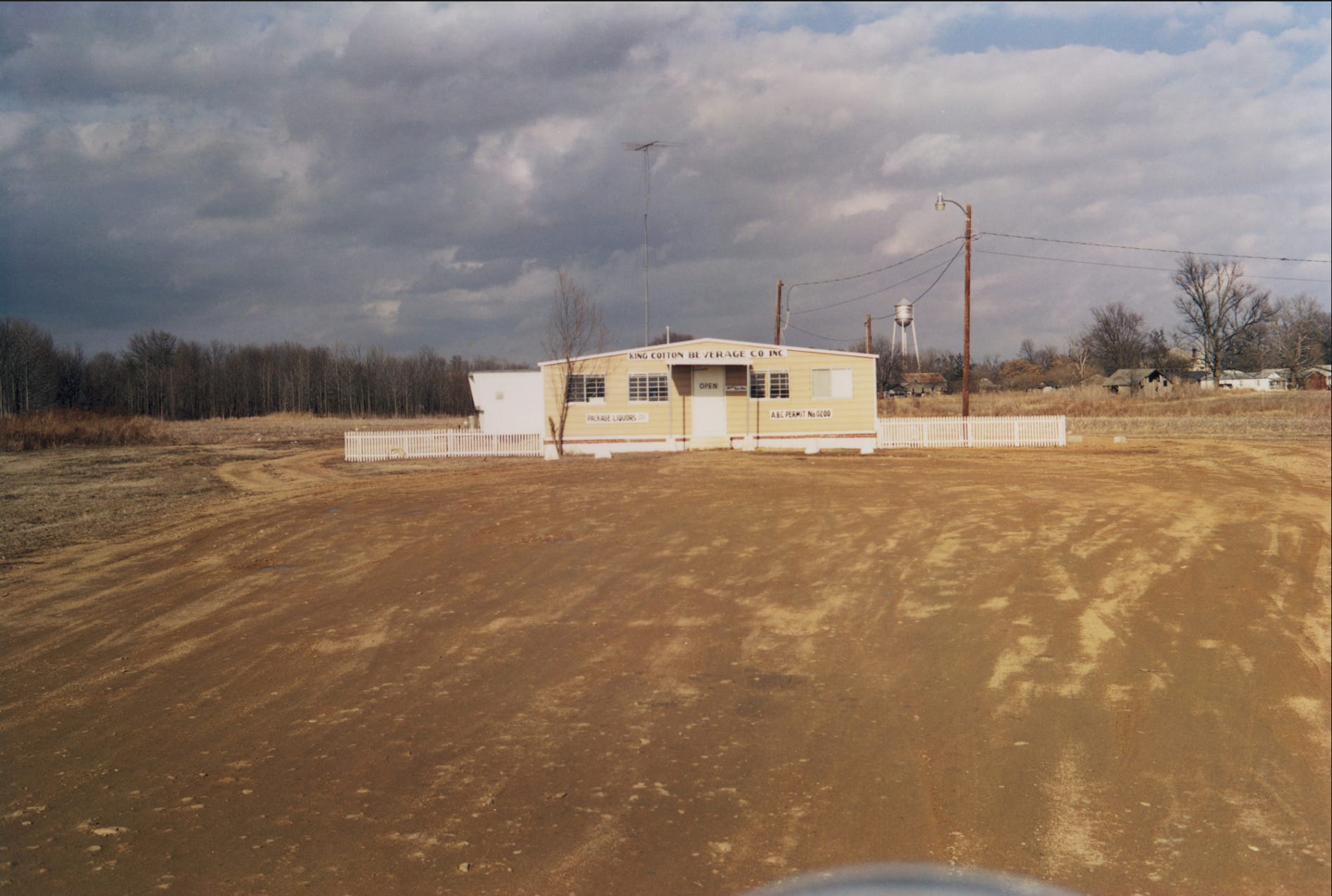
The most striking aspect of La Fabrique de chaises is the sky, a body of profound openness that recalls the sensation of gazing up at the sky while driving on a Texas highway. The factory’s saturated roof against the looming clouds brought to mind the photographs of William Eggleston, one of the early leaders of color photography. The grand sky of the American South holds a commanding presence in many of Eggleston’s images, with one photograph from Tallahatchie County, Mississippi bearing a particular resemblance to La Fabrique de chaises. Like Rousseau’s factory, Eggleston captures an industrial building, white signage with black text atop the structure’s beige body, sitting on a dirt plane. Trees line the horizon behind the building in each work, with Eggleston replacing Rousseau’s smokestacks with a silver water tower. Yet it is the looming sky, occupying a vast swath of space in each work, that shapes Rousseau’s canvas and Eggleston’s photograph — an unexpected parallel between Alfortville in the Parisian suburbs and the rural Tallahatchie County in Mississippi. The composition, it turns out, was not bound to either.
—
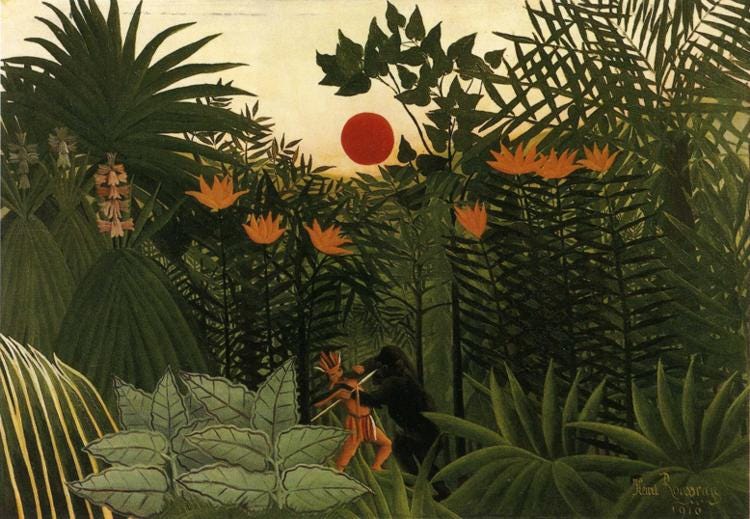
The evening after seeing Rousseau’s exhibit I departed Charles de Gaulle Airport for Jakarta, heading to a foreign, faraway territory the likes of which Le Douanier only explored in his imagination. Several days later, I stepped aboard the new high-speed train at Jakarta Halim Station to head to the city of Bandung. As the train escaped the urban sprawl of the capital, we soon crossed through vistas of lush, tropical greenery — trees that recalled those of Rousseau in landscapes which he never physically experienced. The scenes of exotic jungles that appear in Rousseau’s most celebrated works are the result of his visits to the Jardin des Plantes as well as images and second-hand accounts of these faraway destinations, places that were romanticized in the French colonial imagination. The final rooms of the exhibit are dedicated to these works. Paintings such as Paysage exotique avec un gorille attaquant un homme reveal how Rousseau imagined these far-flung places, stacking countless species of shrubbery in a collage of varying shapes and shades of green leaves interspersed with delicate pink and orange blossoms. The scene felt like it could stem from the thick groves of trees on the horizon beyond the train window.
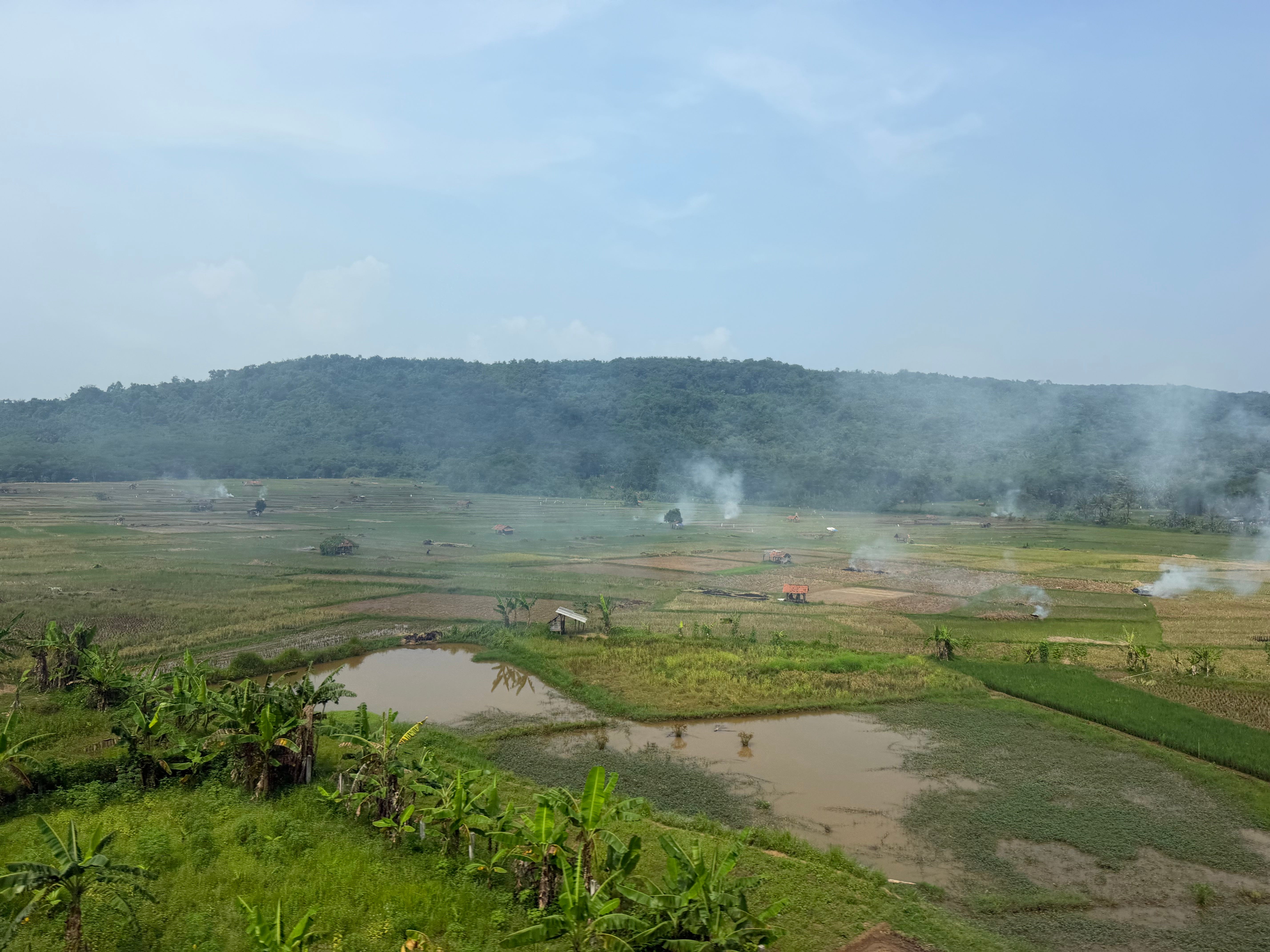
Cruising through the greens of Java, my mind drifted to the views from my typical train commute to school aboard the RER C, leaving Paris to cross through the small towns and countryside south of the city that inspired numerous early Rousseau works. I pondered the chestnut and oak trees that line sections of the track, how they transform from barren in winter to full bloom in spring — a stark change from the tropical Indonesian landscape outside my window that remained lush year-round. Rousseau’s connection to his surroundings in the wider Île-de-France region can at times be overlooked amongst his iconic canvases of the jungles of his imagination. Yet in works such as Les Rives de la Bièvre près de Bicêtre, Rousseau seemingly implants elements of the tropics onto the Francilien landscape. The painting captures a trail one can still stroll along today, a trail which transforms from bare brown branches to a verdant canopy of green with the arrival of spring. Les Rives de la Bièvre reflects a sense of astonishment at this annual shift, while the almost impossibly green trunks and branches intersecting overhead hark closer to a jungle than the Parisian suburbs.

Strolling through the Tuileries in bloom before seeing the exhibit is a far more congruous entry into Rousseau’s world than coming off the streets under a barren gray sky. It is pertinent not as an allegory to the blue skies and green leaves of spring, but rather because it helps us better understand the link between the Francilien landscapes Le Douanier was internalizing and how these fed into the remarkable canvases that fill the walls of the final galleries. Yet it also helps us appreciate how Rousseau would at times borrow elements from the jungles of his imagination for his French landscapes. The anonymous artist of L’Amiral de Graville and the Flemish masters who preceded Rousseau by centuries could not have anticipated a painter who would absorb their flattened planes and choreographed compositions and transplant them — first to the suburbs of Paris, then to jungles he had never set foot in, then, as Eggleston would later show, to the American South. That is the scope of Rousseau’s reach: not despite his influences, but because of how freely he drew from them to create works that could belong to no other artist.
Luca Johnson
Jakarta, Indonesia
April, 2026
Once again you draw surprising and unexpected parallels that draw me to Rousseau in a way I would never reach on my own. Thank you.
What a satisfying read!! Thank you Luca. I hope people come across your essay before they follow those steps to the Rousseau exhibit. They’ll be fortunate.